
MEDIA

Nezih Ünen’s multifaceted artistic production has found powerful resonance across different fields of media over the years. This journey, which began in the early stages of his career with corporate audio designs and songs that left a mark on popular culture, evolved into a far more prestigious and transcendent vision, achieving a universal scale through the Lost Songs of Anatolia project.
Sedat Ergin – May 18, 2017 | Hürriyet
The Bridge Where Anatolian Melodies Meet Western Music: Nezih Ünen shares an anecdote that took place in the Black Sea region in the past, which he heard from a friend. While his friend was driving through the misty hills of the Black Sea, an elderly woman walking by the roadside was singing a folk song they had never heard before. The song was so beautiful that he immediately wanted to get out of the car and record it; but as fate would have it, the tape recorder’s battery was dead. “Never mind, my dear...” smiled the elderly woman, “these folk songs do not leave these valleys anyway.”
In the introductory text of the Lost Songs of Anatolia album, Nezih Ünen recalls the words of this woman and says: “With an effort spanning years, we traveled all over Anatolia. To find those songs and to draw them out from those valleys, fields, and villages.”
Ünen, who turned to music and composition after studying mechanical engineering at Boğaziçi University, composed his first film score in 1987 for the TRT television series Yarın Artık Bugündür, written by Attilâ İlhan. In this work, he operated through a format that brought Anatolian themes and Western music together. Since that date, a single thought has occupied Ünen’s mind: to map the sounds of Anatolia...
He opens up about this idea to Hasan Saltık, the owner of Kalan Müzik, who has a well-deserved reputation for compiling and archiving the ethnic music of Anatolia. Saltık not only helps him but also introduces Ünen to two important figures in music: Birol Topaloğlu, an authority on Black Sea music, and Melih Duygulu, an academic with significant work in the field of ethnomusicology.
Ünen charts a route for himself, and in September 2002, they hit the road with a team of seven people consisting of a production supervisor, a stagehand, two camera operators, a sound recordist, himself, and a driver. He occasionally takes on the role of the third camera operator.
The destination is first the Western Black Sea, with the first stop being Zonguldak. In the following days, they cross over to Tokat via Kastamonu, and from there to the Eastern Black Sea. Afterwards, a journey lasting approximately one month is made along a route that turns toward the East and Southeast, and then descends to Mersin via Central Anatolia.
This is a kind of musical archaeology. In the villages and towns they visit, they are in pursuit of local, authentic sounds. The recordings are captured right then and there, at the very spot they find those sounds. Entirely unexpected recordings are also made. For example, Mehmet Şah Türküz, a shepherd they encounter on the road in Kars, sings the Kurdish folk song 'Delale mı Way' (My Beloved) to them with the most poignant interpretation possible.
In Diyarbakır, they come across young girls working in a cotton field. The 'Worker's Folk Song', which begins with the lyrics “This field is a cotton field, come around / This field demands cotton, come around / The workers demand money, come around...”, is recorded right there in the cotton field. In Muş, they would record dengbejs chanting Kurdish hoyrats, and in Silifke, a semah ritual of the Alevis. One of the most striking recordings is the anonymous 'Köprü Ortasında' (In the Middle of the Bridge) lament, sung in their unique dialect by three elderly women in Hemşin, Rize, telling the story of a young girl who fell from a bridge and died in the river.
When they return to Istanbul, they begin studio production. However, Nezih Ünen feels that he is only at the beginning of the road. Three years later, in 2005, he traverses a similar route—this time with a larger team consisting of three vehicles and four camera operators—visiting villages and towns he had not been to before.
Thousands of kilometers are covered during both trips. 350 hours of video footage are recorded. 133 performances are filmed across 121 different locations. In the documentary film Lost Songs of Anatolia prepared by Ünen, only 43 of these recordings are shown. The album, on the other hand, features 14 songs.
SUFIS, RUBAIS, KURDISH STRANS...
The intricate part of the project is the production phase. This requires a very long and arduous process. Moreover, this time there is a musical challenge. The audio recordings will be brought together with Western-style arrangements. This is the crux of the project. The work will culminate in a documentary film and also an album.
The musical objective here is the integration of recorded authentic melodies into Western-style arrangements. Nezih Ünen writes most of the arrangements. Serhat Ersöz, the keyboardist of the legendary band Moğollar, undertakes a portion of them. For each melody, a separate musical texture is designed in the background to complement and enrich it. Electronic sound effects are utilized extensively, always backed by a powerful rhythmic structure...
While the original field recordings are later brought together with the arrangements recorded in the studio, the fact that there is not the slightest glitch in the flow of the music, that a perfect tempo sync is achieved, and that this seamlessly matches the visual footage probably constitutes the most vital factors in the project's success. There is highly intricate craftsmanship in this part of the work. As a result, the songs of our Anatolia present themselves to us with a different identity each time in this project. We can point to the ghazal 'Gam-ı Aşkınla' by Kamil of Urfa, performed by Naci Yoluk of Urfa with his cümbüş, as the most striking example.
In Nezih Ünen’s arrangement, while a musical texture heavily reminiscent of Pink Floyd surrounds this soulful ghazal, guitar parts that are by no means inferior to David Gilmour's guitar solos complete this musical richness. Another similar arrangement is the transformation of the 'Köprü Ortasında' lament, sung by the charming women from Hemşin (Meryem Seyhan, Zekiye Bakır, Reyhane Alkan), into a vibrant song with a reggae rhythm. While Ahmet Dede plays and sings the nefes of the 16th-century Bektashi poet Hasan Dede—which begins with the lines “Eşrefoğlu al haberi / Bahçe biziz gül bizdedir”—with his saz, a strong rock texture greets this Alevi melody from behind.
Ultimately, different melodic genres of Anatolia—uzun havas, nefes, bozlaks, manis, Kurdish strans, Yörük folk songs, ghazals, epics, semahs, rubais, Black Sea folk songs, and work songs—all line up and greet you in a grand parade accompanied by Western arrangements.
ANATOLIAN AND WESTERN MUSIC HAND IN HAND...
“The harmony between Anatolian music and Western music is a highly fascinating subject for me...” says Nezih Ünen, explaining what he wanted to achieve musically: “It has always bothered me that Anatolian music has not been sufficiently introduced to the world. Yet, we see that many countries have brought their authentic music to a point where it can compete globally. My goal is to present the authentic music of Anatolia formatted within world-class arrangements. In doing so, we express our songs and melodies to the world through the shared musical standards of the West. A foreigner might not initially be interested in our local music, such as a traditional folk song. However, when the same song is presented within a Western format while preserving the original vocal performance, it can very well capture their attention.”
“It became a work rich in emotion and unique in technique,” says Ünen for the project to which he dedicated many years of his life. Six years elapsed between the wheels of the minibus turning for the first time in 2002 and the completion of the documentary in 2008. The film premiering at the 2008 Istanbul Film Festival, followed by screenings at numerous international film festivals. It took until 2010 for the DVD and the album to be released.
The most significant problem encountered by this highly interesting and colorful project is that it has not come to the forefront of society as much as it deserved. For some reason, the awareness of the project remained very limited. A major step taken to overcome this was the Lost Songs of Anatolia project being performed as a live concert series. Finally, the inclusion of the Lost Songs of Anatolia project in the Zorlu Jazz Festival program was an invaluable opportunity not to be missed for those who have known the album since the day it came out.
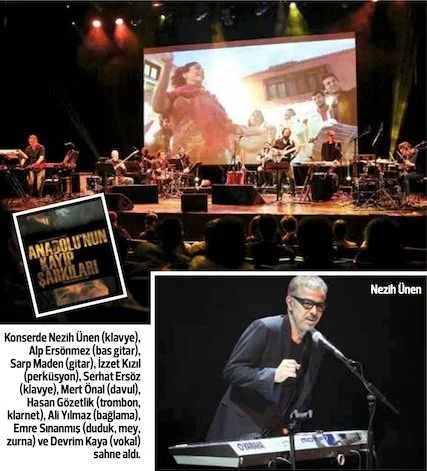
And on Sunday evening, May 7th, the band—mostly consisting of the musicians who participated in the project during the recording period—took the stage at the Zorlu Performance Arts Center and performed 'Lost Songs of Anatolia' with a flawless performance accompanied by the documentary footage on the screen. It was a deeply impressive performance where these highly valuable musicians showcased their mastery.
Taking his place at the keyboard on stage, Nezih Ünen, together with his friends, guided us across a bridge where the melodies of Anatolia hold hands with Western music. The main goal now is for more people to cross the same bridge and meet this synthesis through new concerts to be organized.
Can Dündar – August 10, 2009 | Milliyet
Yaşar Kemal describes Anatolia as “a mosaic of flowers that has filled the cultural garden of the world with beautiful lights.” He adds, “We must protect this mosaic with utmost care.”
The words of President Abdullah Gül, which made the front page of yesterday’s Milliyet, align with this understanding. Gül embraces Byzantium as much as Malazgirt. He considers “Mem u Zin” a heritage just like Dede Korkut. He sees both Ahlat and Ani as "ours."
The "mosaic," which once received constant backlash from chauvinists, is regaining its respect. The first step toward social peace is for the state to break away from racism and approach every flower in the garden with the same respect. If we can do this, that fertile soil will yield tenfold.
A film we watched last weekend at the documentary festival in Kosovo made us take our hats off to that richness once again. Five years ago, when hitting the road to shoot his first documentary, Nezih Ünen told his team, “We don’t have a script: Anatolia will write it; we will shoot it.”
And shoot it he did...
He went to every corner of Turkey and recorded the authentic performances of the local people. Blending his musicianship with his photography, he shot 350 hours of footage in 5 years. He dusted off a cultural heritage on the verge of extinction and restored its initial brilliance. Then, he archived it and fit it into a unique musical box.
“Lost Songs of Anatolia” reminds us of what a colorful cultural garden we live in. Ünen’s camera sometimes climbs to the Black Sea to record those dancing the horon, and sometimes descends to Mardin to immerse itself in the church liturgies of the Syriacs. Anatolia plays kılıç kalkan (sword and shield) in Bursa; spins the semah in Sivas; sings the bozlak in Yozgat. In Istanbul, Armenian, Greek, and Hebrew songs join this garden.
Grandmothers reciting epics, immigrants singing rebetiko, dengbejs chanting laments, zeybeks stamping their knees, dervishes whirling... Drums, zurnas, tulums, bağlamas, sipsis, cümbüşes, bendirs, kemanis... The folk songs we sing in weddings, in longing, in migration, and in grief—used to pour out troubles, heal the sick, soothe sheep, and declare love...
Laments, deyişes, ghazals, and lullabies sung while forging iron, picking cotton, winding silk, washing clothes, reaping crops, digging the soil, rolling dough, and rocking babies to sleep...
Ünen recorded all of them in their purest form and adorned them with magnificent imagery; then, in the studio, he enriched, updated, and beautified them with guitars, duduks, neys, and clarinets. The result is a gorgeous picture of a rainbow that rejects all discriminatory interpretations regarding Anatolia.
This film documents a cultural capital that the epidemic of popular culture—which rejects differences and homogenizes everything with an exclusionary national understanding—has tried to wipe out hand in hand...
It records perhaps the very last voices of the Anatolian people, whose teeth have fallen out, whose voices have grown faint, and whose eyes have lost their spark, but who have never lost their appetite for playing, singing, and dancing.
Looking at the grandmother sighing after her folk song in the final scene, Anatolia resembles a sunken wealthy soul whose entire existence has been plundered by skull-hunters...
It looks weary and exhausted.
But at the same time, with all its beauty, it says, "Do not lose hope in me."
“Even if my flowers wither, I am a unique cultural garden that, when watered, yields tenfold once again.”
Tolga Akyıldız – April 26, 2008 | Hürriyet
My friendship with Nezih Ünen dates back many years. Nezih is a man who came to Istanbul as he welcomed his twenties, studied engineering, yet could never defeat the love of music inside him. Actually, his mind operates with the mathematics of a studio man.
He has put his signature under many important works to date. He is a producer, a composer, an arranger, a performer, and a music video director. You might not know it, but he is also the architect behind the success that Özcan Deniz has recently achieved in his own category.
Years ago, there was a track that became very famous, with a sound far ahead of its time: Haremde Dans (Dance in the Harem). It was the trademark of the project called Yasak Elma, which Nezih Ünen made during a period when he was not yet widely known. Süper FM used this theme as a jingle for years. Then there is his well-known song Çingene Yüreğim. He has been involved in and added value to many projects without you even noticing.
However, a certain excitement had been brewing inside Nezih for a long time. For about 5 years, he had been striving to realize a project that is very special to him, but fundamentally holds great significance for the cultural heritage of this country.
The project is titled Lost Songs of Anatolia. A feature-length documentary/musical brought to life under the direction of Nezih Ünen. Its subject is the musical journey of 10,000-year-old Anatolian culture. “It doesn't have a script. Anatolia created it, we just shot it,” says Ünen. He adds, “Anatolia, the last great civilization of the world, had something to say to the Western culture that has fascinated us for years. I merely mediated this.”
During filming, Nezih traveled all over Anatolia and covered 40,000 kilometers. He captured 133 authentic performances with his camera. He spent exactly 4 years editing and selecting 43 of these performances. And he dedicated 3 years to re-arranging some of the performances he shot in a fitting and proper manner.
RECEIVED A STANDING OVATION
This important film by Nezih Ünen was screened recently as part of the 27th International Istanbul Film Festival. Following that, on the same evening, a concert took place under the concept of Lost Songs of Anatolia at Babylon Istanbul. I must particularly note that both the Beyoğlu Cinema—where the first and only screening of the film took place—and the concert featuring prominent musicians such as Alp Ersönmez, Sarp Maden, Mert Önal, Serhat Ersöz, Osman Aktaş, and İzzet Kızıl as the "Nezih Ünen Band" were packed to the brim with audiences giving a standing ovation. Everyone felt proud of the work done.
Syriac hymns from Mardin, Circassian dances from Düzce, semahs and folk songs from Tokat, Hemşin and rhyming folk songs from Rize, the eagle dance from Bingöl, kılıç kalkan from Bursa, zeybek from Denizli, bozlak from Kırıkkale, Romani drums and zurnas from Muğla, troubadour duels from Kars, dervishes whirling from Istanbul, Armenian and Greek songs...
If I tried to list them all here, I wouldn’t be able to finish. The songs and dances of that 10,000-year-old admirable culture, namely Anatolia, which are on the verge of vanishing...
So, how will you watch this film? Unfortunately, you have to wait a little. Because it will hit the theaters in the fall. Still, I would like you to watch the trailer now to get an idea.
A Worker from Gebze – September 30, 2011 | Workers' Solidarity Association
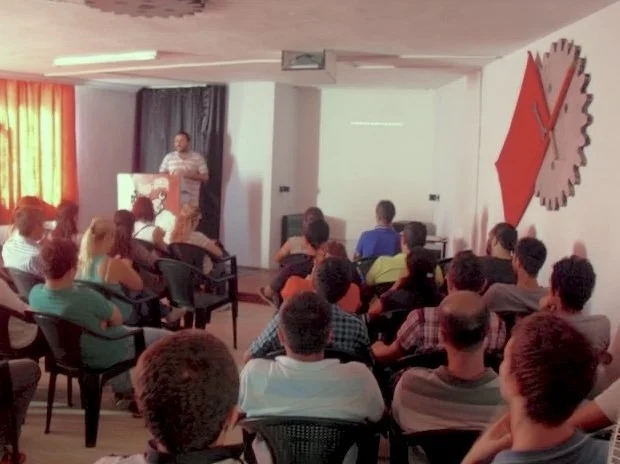
On Sunday, September 19th, at the UİD-DER Gebze representative office, we watched the documentary film Lost Songs of Anatolia together with our fellow worker and student brothers and sisters who attended our event.
The director has tried to project the cultures, music, and laments of Anatolia—which have remained silent for thousands of years—into the present day as if crying them out. This tremendous musical richness shows us that the Georgian, Kurdish, Laz, Armenian, Turkmen, Arabic, Caucasian, Circassian, and Syriac peoples are all parts of the shared culture of these lands. The peoples reflect their happiness, sadness, joy, and pain through a shared language: music. They have strived to reflect and keep their cultures alive through the folk songs they vocalize and the instruments they play.
Due to oppression over the years, the ancient peoples of Anatolia could not sing their folk songs or laments in their own languages. Those who tried to do so were thrown into dungeons. We have not forgotten those who wanted to lynch Ahmet Kaya right then and there—and the dominant mindset they reflected—simply because he said, "I will put a few Kurdish tracks in my new album." Through the folk songs we sing, we express our rebellion, our love, and many other emotions. Through laments, experienced pains are poured out. In fact, playing music is the outward expression of sentences we want to say but cannot. It is the reflection of our emotions.
The lost songs of Anatolia are the outcry of the peoples. The folk songs of the Anatolian peoples will not be silenced. The brotherhood of the Anatolian peoples will give the finest answer to those trying to silence their songs. People who watch this important documentary will probably replace the paranoia of “the Turk has no friend but the Turk” with the realization that these peoples have been brothers for centuries and will remain brothers from now on.
Long Live the Brotherhood of Peoples!
Uğur Biryol – March 20, 2010 | Bianet
The soundtrack CD of Nezih Ünen’s Lost Songs of Anatolia, which has been in production for seven years, is in music stores under the Kalan Müzik label before the film hits the theaters. The defining feature of the musical documentary, which will be screened in March with the slogan “A century of silence is ending!”, is that the authentic sounds and images recorded live and without rehearsal in remote corners of Anatolia are arranged with universal sounds.
Regarding the Lost Songs of Anatolia project, Nezih Ünen says: “Approximately a century ago, as a result of technological developments, sound became recordable, replicable, portable, and sellable. The record industry was established. Every culture spread its own songs, music, and sounds to the world by recording them. Cultures blended into cultures, evolving to form new cultures. Except for Anatolia, the home of the world's oldest settlements, and therefore civilizations. Why? Perhaps because we did not fully appreciate its value, and perhaps due to political anxieties. What concerns us is to take action without waiting for this precious heritage to vanish or be plundered by others. The year is 2010. This silence is ending. Together with our own people, the entire world will hear Anatolia and its voice this year.”
FROM BOZLAK TO EPIC…
There are a total of 16 tracks in the Lost Songs of Anatolia album. Laments, folk songs, and pieces from all four corners of the country have taken their place in order. The work begins with the piece "Döne'm Zülüflerin Deste Deste"belonging to the Gaziantep-Barak region, performed by Mehmet Demir. The compilation, continuing with the Tunceli-Hozat folk song "Eşrefoğlu Al Haberi", features one of the surprises: the chance to listen to the "Kalktı Göç Eyledi Avşar Elleri" bozlak from the voice of Muharrem Ertaş, the unforgettable saz virtuoso and father of Neşet Ertaş.
From the Yörük folk song "Beyköylü Ali Bey" performed by Halil Er, to the Diyarbakır folk song containing the lyrics “This field is a cotton field, come around / This field demands cotton, come around / The workers demand money, come around / The bosses demand the stick, come around / The sergeants demand the stick, come around”, and the Urfa folk song named "Gam-ı Aşkınla", it is possible to see how the cultural diversity of Anatolia is reflected in music.
The album's tracks extending to the Eastern Black Sea are "Köprü Ortasında" and "Derenin Kenarına Yattım", belonging to the Hemşin region. "Köprü Ortasında" was included in the album to exemplify the epic as a type of lament in the Black Sea. In the epic voiced by three Hemşinli women, a lament is chanted for two young girls—the first who fell from a bridge and died, and the second who went to Izmir and passed away. As for "Derenin Kenarına Yattım", it is like a breeze coming from the heights of the Kaçkar Mountains... Ufuk and Firdevs Altay sing this ancient epic so gracefully that it gives the listener goosebumps.
THANK YOU TO THE LOST SONGS
Anatolia continues to live on top of a massive cultural heritage, defying those who wish to reduce its richness to a "singular type." In response, Lost Songs of Anatolia, like a projection of our cultural past, allows us to take a deep breath within the frantic rush of daily life. We cannot thank Nezih Ünen, his team, and those who performed these invaluable folk songs enough.